
6 Effective Methods for Placing Stop Loss Orders – Pros and Cons
⏱️ Estimated Reading Time: 7 minutes
📝 Summary: This guide compares six distinct strategies for placing stop loss orders, including Bollinger Bands, Trendlines, Fibonacci levels, and ATR, highlighting the pros and cons of each to help traders minimize risk.
A disciplined approach to placing stop loss (SL) orders is crucial, as it removes emotional and impulsive reactions to failed trades—something that most traders find difficult to manage. Placing a random SL without a clear rationale often leads to poor outcomes. However, when you understand the direction of your trade and have a defined reason for your SL level, consistently applying the same method can reduce the temptation to override your own rules.
Table of Contents
Key Takeaways
- Context Matters: Never place a fixed stop loss (e.g., 20 pips) without analyzing market structure.
- Volatility: Tools like ATR and Bollinger Bands adjust your stop loss based on current market noise.
- Structure: Using Trendlines and Fibonacci levels places your stop behind natural barriers.
- Adaptability: No single method works for all markets; choose the one that fits the current volatility.
1. Bollinger Bands
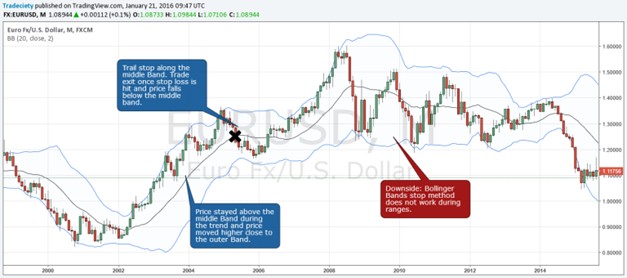
Best suited for trend-following traders, Bollinger Bands help identify optimal stop placement levels. In an uptrend, price movements typically approach the outer bands. When a trend loses momentum, price pulls back toward the middle band (the moving average).
- Conservative strategy: Place the SL just beyond the opposite outer band.
- Trend-following strategy: Set the SL around the middle band and adjust as the trend evolves.
Pros: Dynamic adaptability during trending phases.
Cons: Less effective in ranging or sideways markets.
2. Trendlines, Support, and Resistance
Trendlines are widely used for stop placement due to their role as natural support and resistance levels. A break of the trendline often signals a weakening trend, justifying the placement of the SL beyond that line.
Key consideration: Trendlines can be drawn subjectively. For caution, it’s advisable to connect wick extremes to avoid false signals during short-term volatility spikes.
Risk Warning: Many traders place SLs directly on these lines, making them vulnerable during stop-hunt events or liquidity squeezes.
3. Fibonacci Levels
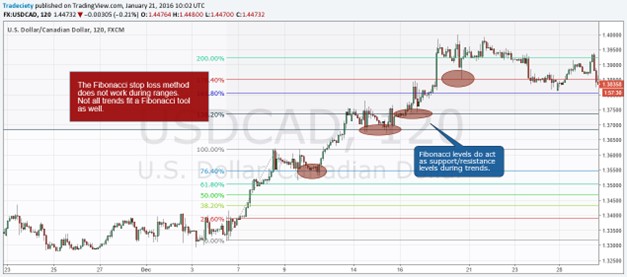
Fibonacci retracement levels act as psychological zones of support and resistance. After identifying a potential entry and a valid 1–2 leg formation, use retracement levels (e.g., 38.2%, 50%, 61.8%) to place SLs logically.
Pros: Offers structurally defined levels that are widely monitored in the market.
Cons: Requires a clear swing structure. During trend inception or in narrow ranges, reliable 1–2 formations may be absent.
4. Moving Averages
Moving averages can also serve as SL guides. When the price trends, it typically moves away from the moving average. Reversals are often preceded by price returning toward the average.
- Commonly used MAs: 50, 100, and 200-day simple moving averages (SMA) serve as natural dynamic support/resistance.
- SL placement: Set SLs just outside these key MAs to give the trade room to breathe.
5. ATR (Average True Range)
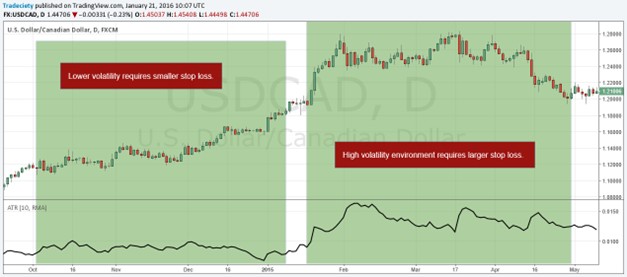
Using the ATR for SL placement offers a dynamic, volatility-based approach. When ATR values are high, they indicate increased market volatility, warranting wider SLs to prevent premature exits. Conversely, during low volatility, tighter SLs can be employed.
Pro Tip: Use the Keltner Channel, which incorporates the ATR, to visualize volatility bands and assist SL placement.
6. Price Patterns and “Natural Price” Levels
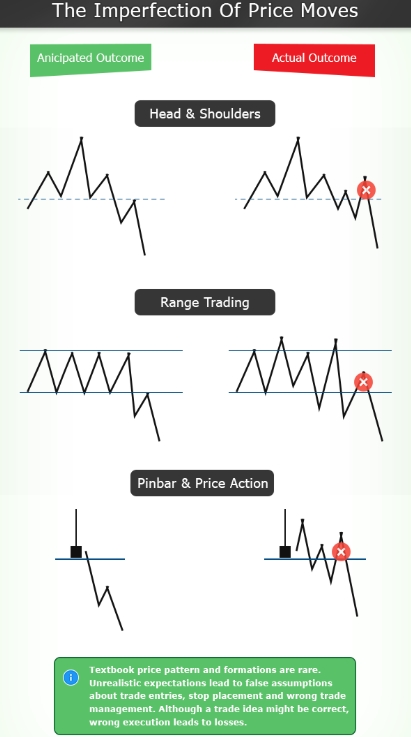
This widely adopted method uses chart patterns (e.g., pin bars, Head & Shoulders) to place SLs just beyond key structural levels.
- Pin bars: SL is set just beyond the high/low of the formation.
- Head & Shoulders: SL is placed on the opposite side of the neckline.
Caveat: This method is well known and often targeted during liquidity hunts (“retail stop runs”). Combine ATR-based buffers with pattern-based SLs to reduce exposure to market manipulation.
Bonus: The Time Stop
Applicable to all the above methods, a time stop involves exiting a trade when price stagnates without confirming your bias. If price remains stagnant after your entry—contrary to your bullish/bearish expectation—it suggests the trade thesis may be invalid. Cut the loss early if your setup fails to materialize. Don’t wait and hope.
Putting It All Together
Setting a fixed SL distance (e.g., 5, 10, or 20 points) is often based on convenience rather than market context. This undermines risk management principles. Always analyze SL levels in the context of price action and market structure. There are no shortcuts in professional trading.
Ready to trade with better risk management?
Open a trading account today and earn cashback on every trade you execute.
Frequently Asked Questions
What is the best stop loss method for beginners?
For beginners, placing stops beyond recent Support and Resistance levels or Swing Highs/Lows is the most intuitive and effective method, as it relies on visible market structure.
Why shouldn’t I use a fixed pip stop loss?
A fixed pip stop (e.g., 20 pips) ignores market conditions. In high volatility, 20 pips might be noise; in low volatility, it might be too wide. Always adapt your stop to the market context.
How does the ATR help with stop loss placement?
The ATR (Average True Range) measures market volatility. Using it ensures your stop loss is wide enough to withstand normal price fluctuations but tight enough to protect capital if the trend reverses.
Related Articles:
⚠️ Disclaimer: The content of this article is strictly for informational purposes and does not constitute investment advice. FXRebate is a cashback and affiliate service, not a broker or fund manager; responsibility for trades and funds lies exclusively with the third-party broker. Trading with leverage involves high risks of capital loss. Partner links used do not generate additional costs for you.