

Active vs. Passive Investing: And the Winner Is…
⏱️ Estimated Reading Time: 4 minutes
📝 Summary: This article analyzes the massive capital shift from active mutual funds to passive index funds, exploring the reasons behind this trend and what it means for modern investors.
The debate between active and passive investing has intensified in recent years, with data showing a clear shift in investor behavior. While active management relies on human expertise to beat the market, passive investing focuses on tracking market indexes. The chart below, derived from a report by Elliott Wave International, illustrates a historic divergence in fund flows that every investor should understand.
Table of Contents
Key Takeaways
- Trend Shift: In 2016, active funds saw record withdrawals, while passive funds saw record inflows.
- Cost Efficiency: Passive funds typically offer lower fees, driving their popularity.
- Performance: Index funds simply mirror market growth, avoiding the risk of underperforming managers.
- Market Share: Index funds now represent over 35% of the equity mutual fund market.
1. The Great Divergence
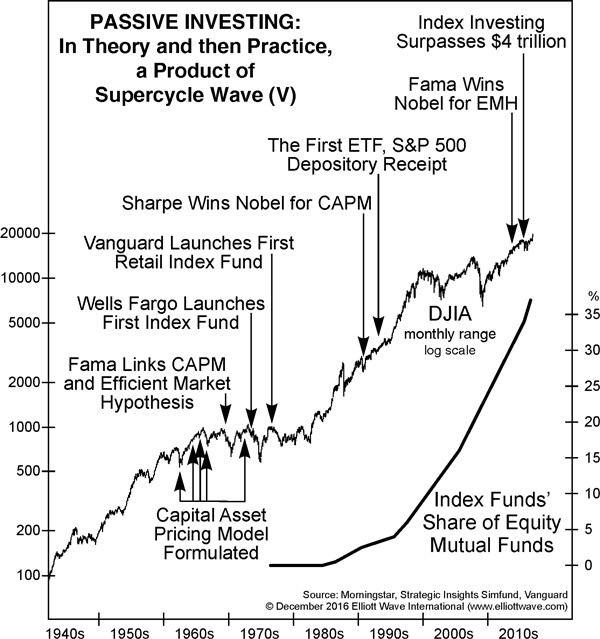
The chart below highlights a dramatic trend in the investment world. It shows the cumulative flows into active versus passive funds, revealing a clear winner in investor preference.
2. What Are Active Funds?
Active funds involve direct human management—specifically, a professional fund manager. Investors who choose active funds are paying for a manager capable of identifying trends in government securities, indexes, stocks, bonds, or other instruments. The goal is to beat the market through strategic allocation and timing.
3. Passive Investing: The Rise of Index Funds
The primary tool for passive investing is the index fund. These funds simply track a market benchmark, such as the S&P 500 or NASDAQ. Instead of trying to outperform the index, the fund replicates its performance.
Historical Context: Index-tracking funds emerged during the bear markets of the 1970s but gained significant traction after 1985. Unlike individual stocks or active strategies that faced volatility during crashes, broad index funds have generally trended upward over multi-decade horizons.
4. Market Share and Growth
The shift is undeniable. Index funds now represent more than 35% of the total equity mutual fund market, with total investments exceeding $4 trillion.
Returning to the chart, 2016 marked a pivotal year:
- Active Funds: Suffered record withdrawals of $286 billion.
- Passive Funds: Enjoyed record inflows of $428.6 billion.
It is reasonable to assume that a significant portion of the capital withdrawn from active managers was redeployed directly into low-cost passive index funds.
5. Why is Money Moving?
Why did the market share of index-tracking funds rise from near zero in 1985 to dominance today? The answer lies in cost and consistency. More investors are choosing to trust the overall market’s long-term trajectory rather than paying high fees to managers who statistically often fail to outperform the benchmark.
Invest smarter, not harder.
Open an account today and access a wide range of global instruments with competitive conditions.
Frequently Asked Questions
Is passive investing safer than active investing?
Generally, yes. Passive investing eliminates the risk of human error by a fund manager and typically has lower fees, though it still carries market risk.
What is the main advantage of index funds?
The main advantages are low costs (expense ratios) and instant diversification across an entire sector or market economy.
Can active funds still outperform the market?
Yes, some skilled managers outperform the market, but statistics show that over long periods (10+ years), the vast majority of active funds underperform their benchmark indexes.
⚠️ Disclaimer: The content of this article is strictly for informational purposes and does not constitute investment advice. FXRebate is a cashback and affiliate service, not a broker or fund manager; responsibility for trades and funds lies exclusively with the third-party broker. Trading with leverage involves high risks of capital loss. Partner links used do not generate additional costs for you.