Capital Management: The Only Way to Survive in Forex
⏱️ Estimated Reading Time: 5 minutes
📝 Summary: This article explores why most traders lose money despite having winning trades, highlighting the critical importance of capital management, risk-to-reward ratios, and controlling the “fight or flight” emotional response.
Capital represents the fundamental element of trading. Without it, you are effectively out of the game. Therefore, safeguarding and managing your capital is not just important—it is essential. Many investors in the Forex market possess prior experience in stocks and technical analysis, yet statistics show that over 80% still incur losses. Why?
Table of Contents
Key Takeaways
- Win Rate Deception: You can be right 60% of the time and still lose money if your losses are larger than your wins.
- The 1:1 Trap: Average losses are often double the size of average wins for retail traders.
- Golden Rule: Always aim for a Risk-to-Reward ratio of at least 1:1.5 or higher.
- Discipline: Never widen your stop-loss order to accommodate a losing trade.
1. The Statistical Reality
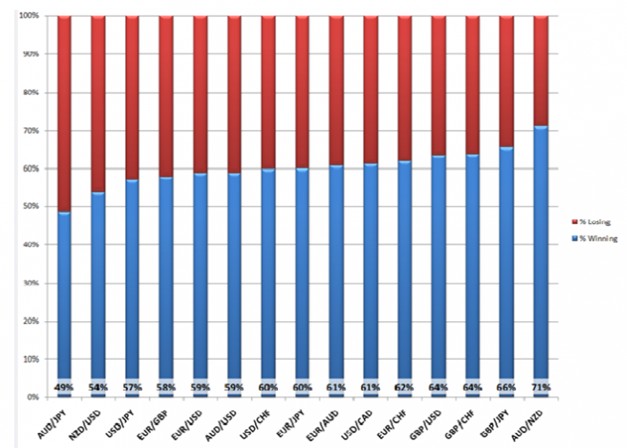
To illustrate the disconnect between making correct decisions and making money, we can refer to statistical data compiled by David Ruiz. The data originates from 12 million real transactions carried out during 2009–2010.
Surprisingly, traders were correct more often than they were wrong:
- EUR/USD: 59% profitable decisions
- USD/CAD: 61% profitable decisions
- AUD/NZD: 71% profitable decisions
2. Why Winning Traders Lose Money
At first glance, one might assume that with a win rate of 60-70%, most traders would be profitable. However, statistics reveal that four out of five traders lose money. The answer lies in the average size of wins vs. losses.
As the table below demonstrates, the average loss per trade significantly exceeds the average profit. For EUR/USD, traders took an average profit of 65 pips but held onto losses for an average of 127 pips.
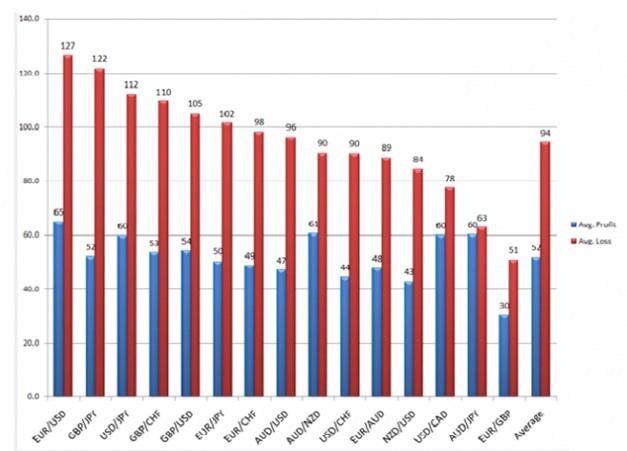
This highlights a fundamental lack of money management. Traders cut winners early out of fear and let losers run out of hope.
3. The Psychological Dimension
We all know, at least in theory, how to secure profits and minimize losses, yet our psychology often dictates otherwise. Human nature compels us to want to be right at all costs, refusing to accept defeat. This behavior is triggered by the “fight or flight” reaction, leading traders to irrationally hold onto losing positions hoping the market will turn around.
4. Key Conclusions for Capital Growth
To reverse these statistics, you must adopt strict rules:
- Analytical Mindset: Remove emotion from the equation.
- Stop Orders: Always set a hard Stop Loss. No exceptions.
- Risk-to-Reward: Aim for a ratio of at least 1.5:1. (Risk $100 to make $150).
- Discipline: Never move your Stop Loss further away. If you are wrong, accept the small loss. Persisting in error only amplifies the damage.
Protect your capital first.
Trade with a broker that values transparency. Open an account and get cashback on every trade.
Frequently Asked Questions
What is the ideal Risk-to-Reward ratio?
A ratio of 1:1.5 or 1:2 is recommended. This means for every $1 you risk, you aim to make $1.50 or $2.00. This allows you to be profitable even with a 50% win rate.
Why do traders let losses run?
It is a psychological bias known as loss aversion. The pain of realizing a loss causes traders to hold on, hoping the market will turn in their favor.
Should I ever move my Stop Loss?
You should only move your Stop Loss to reduce risk (e.g., to break-even). Never move it further away to increase risk on a losing trade.
⚠️ Disclaimer: The content of this article is strictly for informational purposes and does not constitute investment advice. FXRebate is a cashback and affiliate service, not a broker or fund manager; responsibility for trades and funds lies exclusively with the third-party broker. Trading with leverage involves high risks of capital loss. Partner links used do not generate additional costs for you.