
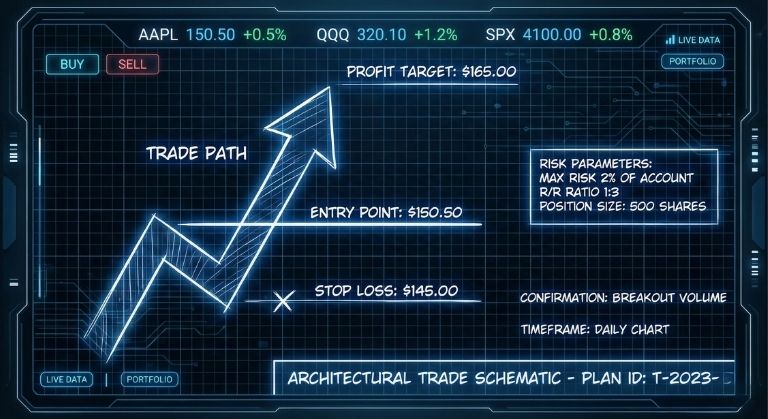
The Trading Plan: Your Roadmap to Forex Success
⏱️ Estimated Reading Time: 5 minutes
📝 Summary: This guide outlines the essential components of a professional Forex trading plan, including defining entry/exit rules, risk management parameters, and the importance of sticking to a strategy to remove emotional decision-making.
Having a trading plan is not optional; it is essential. Without one, you are not trading—you are gambling. A well-structured plan removes emotion from the equation, providing a clear set of rules to follow regardless of market chaos. It transforms trading from a stressful guessing game into a disciplined business.
Table of Contents
Key Takeaways
- Documentation: Write your plan down. If it’s only in your head, it’s not a plan.
- Rules: Define exactly when to enter and exit before you open a chart.
- Risk: Pre-define your risk per trade (e.g., 1%) to protect your capital.
- Focus: Master one strategy before jumping to the next.
1. Why Do You Need a Plan?
Novice traders often suffer from “shiny object syndrome,” constantly switching indicators and systems. This leads to inconsistent results. You can never identify what is wrong with your trading if you change your method every week.
A plan acts as a filter. It allows you to ignore 90% of market noise and focus only on the setups that match your specific criteria. When you know exactly what you are looking for, trading becomes boring—and “boring” is profitable.
2. The Essential Checklist
Your trading plan must be physical (written or digital). It should clearly define:
- Assets: Which currency pairs will you trade? (e.g., EUR/USD only).
- Timeframes: Which charts will you analyze? (e.g., H4 for direction, M15 for entry).
- Entry Rules: What must happen for you to click buy? (e.g., Price crosses 50 EMA + RSI > 50).
- Exit Rules: When do you take profit? When do you admit you are wrong?
- Risk Management: What is your maximum loss per trade? (e.g., $50 or 1%).
3. Consistency Over Variety
There are traders who sit for hours waiting for one specific setup. They might take only 2-3 trades a week. Because they have a well-defined strategy, they don’t feel the need to “force” a trade when the market is messy.
When you lack a plan, you trade based on intuition or emotions (Fear/Greed). You chase candles that are already moving. A plan gives you the discipline to wait for the price to come to you.
4. Adaptation vs. Discipline
It is natural to experiment with different systems when you are learning. However, you must eventually select one approach and dedicate enough time to master it.
The Rule of 100 Trades: Before changing your plan, execute 100 trades exactly according to the rules. Only then will you have enough statistical data to know if the strategy works or if the problem is the trader.
Plan your trade, trade your plan.
Execute your strategy with a reliable broker and get paid for every lot you trade.
Frequently Asked Questions
How often should I update my trading plan?
Review your plan periodically (e.g., quarterly). Only make changes if market conditions have fundamentally shifted or if you have statistical proof that a rule is not working.
Can I have multiple trading plans?
Yes. You might have one plan for Trend Trading (e.g., trending pairs) and another for Range Trading (e.g., sideways markets). Just ensure you don’t confuse them during execution.
What is the most important part of a trading plan?
Risk Management. You can have a mediocre strategy, but if you manage risk perfectly, you can survive. If you have a great strategy but poor risk management, you will eventually blow your account.
⚠️ Disclaimer: The content of this article is strictly for informational purposes and does not constitute investment advice. FXRebate is a cashback and affiliate service, not a broker or fund manager; responsibility for trades and funds lies exclusively with the third-party broker. Trading with leverage involves high risks of capital loss. Partner links used do not generate additional costs for you.