FXRebate Education · Practical trading guide
Quick answer
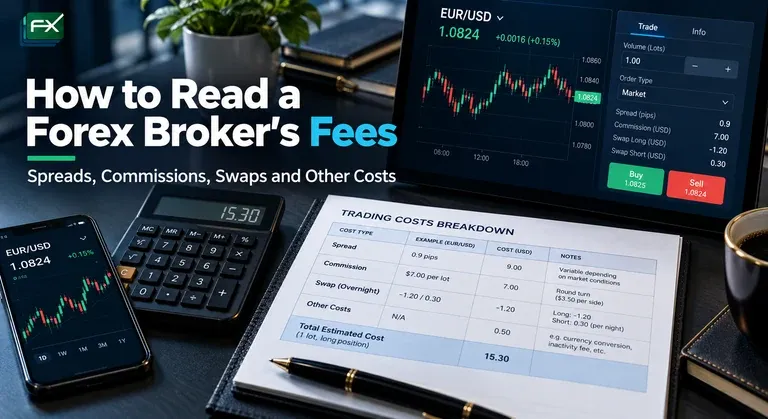
The cheapest-looking forex account is not always the cheapest account to trade. A “zero commission” account can have wider spreads, while a raw-spread account may charge a separate commission. Overnight financing, conversion fees, inactivity fees and execution quality can also affect total cost.
The right comparison is total trading cost for your own trading style.
Key Takeaways
- Spread is the difference between bid and ask.
- Commission may be charged per lot, per side or per round turn.
- Swap/overnight financing matters for positions held beyond the broker’s rollover time.
- Slippage is an execution outcome, not always a quoted fee.
- Rebates can reduce effective trading cost on eligible activity but do not remove market risk.
1. Spread
The spread is the difference between the bid price and ask price.
Example:
- EUR/USD bid: 1.08240
- EUR/USD ask: 1.08249
- spread: 0.9 pip
A tighter spread reduces the immediate difference between the buy and sell price, but the average spread matters more than the “from 0.0 pips” headline.
2. Fixed vs Variable Spreads
Variable spread: changes with liquidity and market conditions.
Fixed spread: designed to remain more stable under defined conditions, although broker terms can still include exceptions.
Check how spreads behave around:
- market opens;
- major economic releases;
- rollover;
- thin-liquidity periods;
- unexpected news.
3. Commission
Raw-spread or ECN-style accounts often charge a separate commission.
Commission can be quoted as:
- USD per lot per side;
- USD per round turn;
- basis points or percentage for some instruments;
- instrument-specific rates.
Always confirm whether a quoted “$3.50 commission” means $3.50 per side or $3.50 for the full open-and-close cycle.
4. Swap / Overnight Financing
When you keep a leveraged position open beyond the broker’s rollover time, a swap or financing adjustment may apply.
The amount can depend on:
- instrument;
- direction — long or short;
- interest-rate differential;
- broker pricing;
- day of the week;
- account type.
Some instruments apply a multi-day adjustment on a particular rollover day to account for settlement conventions.
5. Currency Conversion
If your trading account is denominated in one currency and the instrument’s P&L, fees or settlement is calculated in another, a conversion charge or conversion rate may apply.
This is particularly relevant for traders using multi-asset CFD accounts.
6. Slippage
Slippage is the difference between the requested or expected execution price and the actual fill price.
It can be:
- negative;
- positive;
- zero.
Slippage becomes more likely when prices move quickly or liquidity is limited.
A broker with a tight advertised spread but consistently poor execution may be more expensive in practice than the headline pricing suggests.
7. Other Possible Fees
Depending on the broker and account:
- inactivity fee;
- deposit/withdrawal charge;
- data fee;
- guaranteed stop-loss premium;
- custody or exchange fee for certain products;
- account conversion fee.
Read the broker’s full fee schedule rather than only the forex pricing page.
8. Example: Total Cost of a EUR/USD Trade
Assume a hypothetical one-lot EUR/USD trade:
| Cost component | Example |
|---|---|
| Spread | 0.9 pip |
| Commission | $7 round turn |
| Overnight swap | $0 if closed same day |
| Conversion | $0 if account and fees are in USD |
| Slippage | Depends on execution |
If the position is held overnight, swap becomes part of the total cost. If the market gaps or moves quickly, slippage may materially change execution cost.
9. Standard vs Raw Account
| Feature | Standard account | Raw/commission account |
|---|---|---|
| Spread | Usually wider | Usually tighter |
| Separate commission | Often no | Usually yes |
| Cost visibility | Simple | More components |
| Best for | Depends on strategy | Depends on frequency/size |
Neither structure is automatically cheaper. Calculate your expected cost based on your trade size and frequency.
10. Why Average Cost Matters More Than Minimum Cost
“Spreads from 0.0” means the spread can reach that level under certain conditions. It does not mean every trade is executed at 0.0.
When possible, compare:
- average spread;
- commission;
- swap;
- execution statistics;
- typical slippage;
- trading hours.
11. Where Rebates Fit
A rebate arrangement may return part of the broker-paid referral or volume commission on eligible trading activity.
That can reduce the trader’s effective cost, depending on the broker, account type, instrument and rebate rate.
A rebate does not change whether a trade itself is profitable. It should be treated as a cost adjustment, not as a trading edge that removes risk.
12. Broker Fee Checklist
Before choosing an account, check:
- [ ] typical spread on instruments you actually trade;
- [ ] commission per side or round turn;
- [ ] overnight swap rates;
- [ ] triple-swap day where applicable;
- [ ] conversion charges;
- [ ] deposit/withdrawal costs;
- [ ] inactivity charges;
- [ ] execution/slippage policy;
- [ ] rebate eligibility if relevant.
13. Calculate the Cost for Your Own Strategy
A scalper, day trader and swing trader can experience very different costs on the same account.
High-frequency traders may be especially sensitive to spread and commission. Longer-term traders may care more about overnight financing.
There is no single “cheapest broker” independent of how the account is used.
Related FXRebate reading

Frequently Asked Questions
Is a zero-commission account free?
No. The broker may earn through the spread or other charges.
Is 0.0 spread always cheaper?
No. Add the commission and other costs before comparing accounts.
What is a round-turn commission?
It is the total commission for opening and closing the position. Some brokers instead quote commission per side.
Do rebates reduce the spread?
It depends on the partner arrangement. Some rebate structures pay cashback separately, while some arrangements can involve commission or spread reductions. Eligibility and structure vary by broker.
Your next step
Compare the whole cost, not one headline number.
Review participating brokers, account conditions and eligible cashback in the FXRebate directory. Rebate availability and rates vary by broker, account and qualifying activity.