FXRebate Education · Practical trading guide
Quick answer
When traders say “my broker”, they often mean the brand shown in the app or on the website. Legally, however, the relationship is usually with a specific company within that broker group. That company — the legal entity — determines which regulator supervises the account, which agreement applies, where disputes are handled and which protections may be available.
Understanding this distinction is essential when comparing brokers.
Key Takeaways
- A broker brand can be used by several companies.
- Your Client Agreement should identify the legal entity serving your account.
- Regulation follows the legal entity, not the logo.
- Different entities in the same group can offer different leverage, protections and products.
- Always verify the specific entity before depositing funds.
1. What Is a Broker Brand?
A broker brand is the commercial identity customers recognise.
It can include:
- the trading website;
- logo;
- app name;
- social-media accounts;
- marketing materials;
- customer-facing support.
The brand itself may not be the company that holds your account.
2. What Is a Legal Entity?
A legal entity is the company with which you enter into a contractual relationship.
Its name will normally appear in:
- Terms and Conditions;
- Client Agreement;
- account-opening documents;
- legal disclosures;
- privacy documentation;
- funding instructions.
That company may hold a regulatory licence and is usually responsible for providing the regulated service.
3. One Brand, Several Entities
Consider a hypothetical broker called Example Markets.
The group might contain:
- Example Markets UK Ltd — authorised in the UK;
- Example Markets Europe Ltd — regulated in Cyprus;
- Example Markets Australia Pty Ltd — licensed in Australia;
- Example Markets Global Ltd — serving clients in other jurisdictions.
The website can look almost identical for all users, but the legal relationship can be different.
4. Why Your Entity Affects Regulation
A regulator supervises a specific legal company.
If the UK entity is authorised by the FCA, that does not automatically mean a customer contracted with another group company has an FCA-regulated account.
The same applies to CySEC and ASIC.
This matters because different entities may have different:
- regulatory obligations;
- leverage limits;
- negative balance protections;
- client-money arrangements;
- dispute-resolution processes;
- eligible products;
- marketing restrictions.
5. How to Identify Your Account Entity
Use this sequence:
Step 1 — Read the account-opening page
Look for the company name before submitting your application.
Step 2 — Read the Client Agreement
This is one of the most reliable places to identify the contracting company.
Step 3 — Check the footer
The website footer often lists the group’s regulated entities, but do not assume all of them apply to you.
Step 4 — Review funding details
The recipient company on deposit instructions should make sense within the documented account structure.
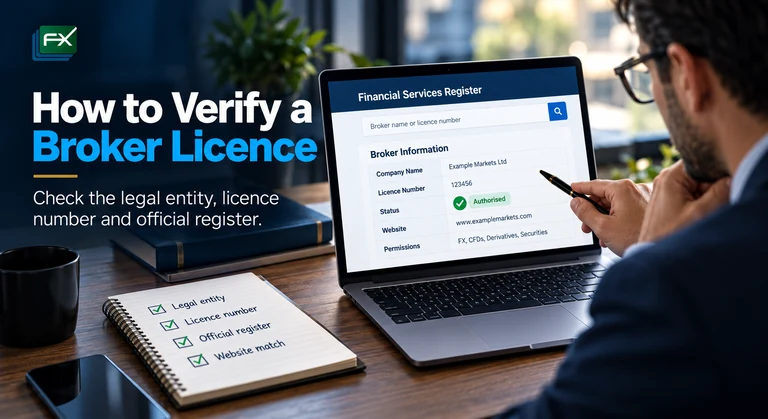
Step 5 — Verify with the regulator
Search the exact legal entity in the relevant regulator’s official register.
6. Why the Domain Matters
A valid company name is not enough.
Clone websites can copy the details of regulated companies. You should therefore compare the domain you are using with the regulator’s records or approved-domain information where available.
CySEC, for example, publishes approved domains for Cyprus Investment Firms, while ASIC has expanded the website information shown in its professional registers. The FCA publishes firm contact information and warnings that can help identify clones.
7. Entity Differences Can Affect Trading Conditions
The same broker brand may publish different conditions for different entities.
Examples include:
| Area | Possible difference between entities |
|---|---|
| Maximum leverage | Varies by jurisdiction and client classification |
| Negative balance protection | May be mandatory in one jurisdiction and structured differently elsewhere |
| Instrument availability | Some products may not be offered everywhere |
| Promotions | Certain incentives may be restricted |
| Client compensation | Availability and scope differ by jurisdiction |
| Dispute process | Different ombudsman or complaint routes |
Always compare the conditions of the entity that will actually serve you.
8. Group Regulation vs Account Regulation
Statements such as “our group is regulated globally” can be factually true but still incomplete for an individual trader.
The useful question is:
Which group company is my counterparty?
Then verify that company.
9. Questions to Ask Before Funding
- What is the full legal name of the company holding my account?
- What is its regulator and licence/reference number?
- Is the website domain recognised by that regulator?
- Which client-money rules apply?
- Which negative balance or margin protections apply?
- What complaints process applies?
- Which country’s law governs the Client Agreement?
10. The Bottom Line
The broker’s brand helps you recognise the service. The legal entity defines the legal relationship.
When comparing brokers, both matter — but only the legal entity tells you exactly who is providing the account and which regulatory framework applies.
Related FXRebate reading


Frequently Asked Questions
Is the broker’s brand name normally the same as its company name?
Sometimes, but not always. Many broker groups use one commercial brand across several legal companies.
Where can I find the legal entity?
Start with the Client Agreement, Terms and Conditions and legal section of the website.
Can two clients using the same broker brand have accounts under different regulators?
Yes. Their country of residence and eligibility can result in accounts being opened with different group entities.
Why does this matter for rebates?
Partner arrangements, eligible account types and rebate availability can also depend on the broker entity and jurisdiction. Eligibility should be checked for the specific account setup.
Your next step
Know the company. Then compare your options.
Once you have identified the entity serving your account, review FXRebate’s broker directory for participating partners and the account options available to you.