Practice Forex Trading: From Paper to Demo
⏱️ Estimated Reading Time: 5 minutes
📝 Summary: This guide explores the evolution of trading practice from historical “paper trading” to modern demo accounts, highlighting the benefits of risk-free learning and the psychological challenges of transitioning to live capital.
Achieving consistent profits in the Forex market is a formidable challenge that requires skill, patience, and strategy. Just as a pilot uses a flight simulator before flying a real plane, a trader must practice in a safe environment. Today, we have sophisticated tools for this, but the concept of “risk-free practice” has deep roots in trading history.
Table of Contents
Key Takeaways
- Risk-Free: Demo accounts allow you to learn platform mechanics without losing money.
- History: Before computers, traders used “Paper Trading” to simulate results.
- Limitations: Demo trading cannot simulate the emotional pressure of risking real capital.
- Goal: Use demos to build a strategy, then transition to small live accounts for emotional training.
1. What is Paper Trading?
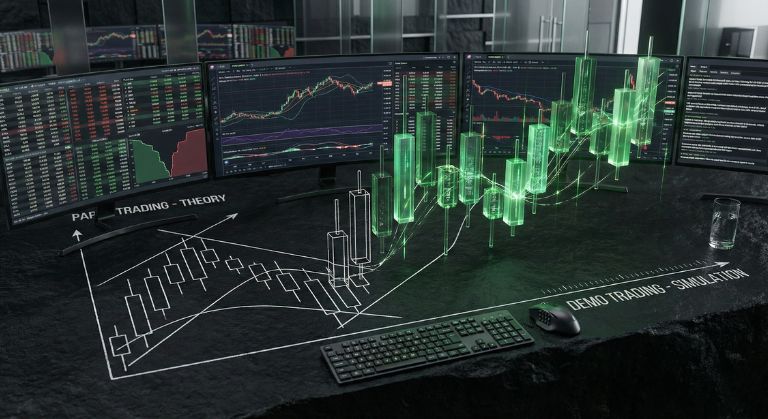
Decades ago, before the internet age, novice investors practiced via paper trading. This literally meant writing down entry and exit prices on a piece of paper to track hypothetical performance.
In the 1930s, opening a brokerage account was complex and expensive. Paper trading was the only viable way for beginners to test strategies without incurring high fees. While primitive, it taught the fundamental lesson that strategy comes before execution.
2. The Modern Demo Account
Today, paper trading has been replaced by the Demo Account. Most brokers offer free access to their trading platforms with virtual funds (e.g., $10,000 or $100,000).
Advantages of Demo Trading:
- Platform Familiarity: Learn how to place orders, set Stop Losses, and use indicators without financial risk.
- Strategy Testing: You can backtest and forward-test trading systems in real-time market conditions.
- Zero Cost: It is free education. You can blow up ten demo accounts and learn valuable lessons without hurting your wallet.
3. The Psychological Trap
While essential, demo trading has a major flaw: It lacks emotion.
When trading with virtual money, you don’t feel fear when the market drops, nor do you feel greed when it rises. You might hold a losing trade calmly because “it’s not real money.” In a live account, that same situation triggers a “fight or flight” response.
The Danger: Success on a demo account does not guarantee success on a live account. The strategies work, but your brain reacts differently to real financial risk. Be aware of this gap.
4. A Structured Learning Path
To transition successfully from beginner to profitable trader, follow this roadmap:
- Phase 1 (Demo): Open a demo account. Focus on learning the platform and developing a written trading plan. Do not move on until you are profitable for 3 consecutive months.
- Phase 2 (Micro Live): Open a small live account with money you can afford to lose (e.g., $500). Trade smallest sizes (micro/nano lots). The goal here is to manage emotions, not to get rich.
- Phase 3 (Scaling): Once you are comfortable with the emotions of live trading, gradually increase your capital and position sizes according to your plan.
Ready to test your skills?
Open a trading account today and start your journey with the backing of our cashback program.
Frequently Asked Questions
How long should I trade on a demo account?
There is no set time, but a common recommendation is to achieve consistent profitability for at least 3 to 6 months before risking real capital.
Are demo quotes different from live quotes?
Generally, no. They use the same data feed. However, execution speed (slippage) in a live environment may differ due to real market liquidity.
Can I restart my demo account if I blow it?
Yes, that is the beauty of it. You can reset the balance or open a new one instantly to try a different strategy.
⚠️ Disclaimer: The content of this article is strictly for informational purposes and does not constitute investment advice. FXRebate is a cashback and affiliate service, not a broker or fund manager; responsibility for trades and funds lies exclusively with the third-party broker. Trading with leverage involves high risks of capital loss. Partner links used do not generate additional costs for you.