

Forex Trading for Beginners: Understanding Lots & Leverage
⏱️ Estimated Reading Time: 7 minutes
📝 Summary: This guide explains the fundamental concepts of position sizing (lots), the mechanics of leverage, and critical risk management strategies to help new traders protect their capital.
Forex trading for beginners offers a gateway to the world’s largest and most liquid financial market, but it operates differently from the traditional stock market. While stocks allow you to buy exact numbers of shares, Forex requires trading in standardized “blocks” of currency known as lots. This guide provides the practical knowledge needed to understand these fundamental principles, specifically focusing on position sizing, the double-edged sword of leverage, and how to start trading independently without risking your entire capital.
Table of Contents
Key Takeaways
- Standard Units: Unlike stocks, Forex is traded in specific units called Lots (Standard, Mini, Micro, Nano).
- Leverage: Allows you to control large positions with small capital, but significantly increases risk.
- Pip Value: The value of a price movement (pip) changes based on your lot size (e.g., $10 for a Standard Lot vs. $0.10 for a Micro Lot).
- Risk Management: Beginners should prioritize survival by trading micro or nano-lots before scaling up.
1. Stock Market vs. Forex: The Key Differences
For those transitioning from stock trading, the mechanics of the foreign exchange market can initially seem confusing. In the stock market, you have the flexibility to purchase a precise number of shares—for example, 50 shares of Apple or 7,523 shares of a smaller company.
In Forex, you cannot simply choose to sell an arbitrary amount like “7,523 euros.” Instead, currencies are traded in standardized amounts known as Lots. This structure ensures liquidity and standardization across the global market.
To navigate this successfully, beginners must familiarize themselves with standard terms. Resources like Investopedia are excellent for deepening your understanding of concepts like Margin and Pips.
2. Understanding Lots and Position Sizing
The “Lot” is the foundational unit of trade in Forex. It represents a fixed amount of the base currency (the first currency in a pair, e.g., the EUR in EUR/USD).
The Four Main Lot Sizes
Most brokers and trading platforms, such as MetaTrader 4 (MT4) or MetaTrader 5 (MT5), offer different tiers of lot sizes to accommodate various account sizes:
- Standard Lot (1.00): Represents 100,000 units of currency. A one-pip movement usually equals $10.
- Mini Lot (0.10): Represents 10,000 units. A one-pip movement equals $1.
- Micro Lot (0.01): Represents 1,000 units. A one-pip movement equals $0.10.
- Nano Lot (0.001): Represents 100 units. A one-pip movement equals $0.01 (Note: Not all brokers offer this size).
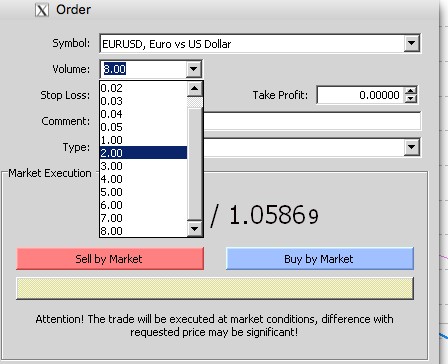
Pro Tip: Always check the “Volume” dropdown in your trading terminal. Selecting “1.00” by mistake instead of “0.01” means you are risking 100 times more money than intended!
3. The Truth About Leverage and Risk
Why do so many traders lose money in Forex? The primary reason is a lack of understanding of Leverage. Leverage is a loan provided by the broker that allows you to control a large position with a small amount of capital (margin).
The Danger of Over-Leveraging
Advertisements often highlight the appeal of starting with just $100 and using 1:500 leverage. While this allows you to open a trade worth $50,000, it is highly dangerous for a beginner.
- Scenario: You open a Standard Lot (100,000 units) with a small account.
- Risk: A movement of just 10-20 pips against you could wipe out your entire balance instantly.
Leverage amplifies both profits and losses. If your trade is correct, the returns are significant. However, if the market moves against you, your funds can be depleted in seconds. This is why professional traders rarely use the maximum leverage available.
4. Why You Should Start Small (Micro & Nano Lots)
Just as you wouldn’t start investing in the stock market with $500,000 without experience, you shouldn’t risk large sums in Forex immediately. The goal of a beginner is not to get rich quickly, but to survive long enough to learn.
The “Nano-Lot” Advantage:
Trading with Micro-lots (0.01) or Nano-lots (0.001) allows you to gain live market experience with real emotions, but with minimal financial risk. If you lose 50 pips on a Nano-lot, you might lose $0.50—a cheap price for a valuable lesson. If you lose 50 pips on a Standard lot, you lose $500.
Before trading with real money, it is highly recommended to practice on a Demo Account first, then switch to a small Live Account. Use this risk-managed approach to test how different lot sizes affect your margin.
Putting It All Together
Forex trading is a skill that requires patience and discipline. Understanding position sizing is the first step toward effective risk management. By choosing the correct lot size relative to your account balance, you ensure that a single bad trade does not end your trading career.
Remember: 1 Lot = 100,000 units. Always double-check your volume before clicking “Buy” or “Sell”.
Ready to start your trading journey?
Open a trading account today and earn cashback on every trade you execute, regardless of the lot size.
Frequently Asked Questions
How much money do I need to start Forex trading?
Thanks to leverage and micro-lots, you can start with as little as $100. However, it is recommended to start with an amount you can afford to lose and to trade small sizes (0.01 lots) to manage risk effectively.
What is the difference between a Micro-lot and a Mini-lot?
A Micro-lot is 0.01 lots (1,000 units), where 1 pip equals approximately $0.10. A Mini-lot is 0.10 lots (10,000 units), where 1 pip equals approximately $1.00. The Mini-lot is 10 times larger than the Micro-lot.
Can I lose more than I invest in Forex?
Yes, due to leverage, it is theoretically possible to lose more than your initial deposit if the market moves drastically and the broker does not have “Negative Balance Protection.” Always check if your broker offers this protection.
How to calculate your Forex Position Size
Follow these steps to correctly determine the size of your trade before entering the market.
- Determine Risk Amount
Decide how much money you are willing to risk on this specific trade (e.g., $10 or 1% of your account).
- Calculate Stop Loss Distance
Analyze the chart and determine where your Stop Loss should be placed in pips (e.g., 20 pips away from entry).
- Select Lot Size
Divide your Risk Amount by the Stop Loss distance to find the value per pip. Choose the Lot size (Standard, Mini, or Micro) that matches this value.
Related Articles:
⚠️ Disclaimer: The content of this article is strictly for informational purposes and does not constitute investment advice. FXRebate is a cashback and affiliate service, not a broker or fund manager; responsibility for trades and funds lies exclusively with the third-party broker. Trading with leverage involves high risks of capital loss. Partner links used do not generate additional costs for you.