

How to Set a Stop Loss Order: Strategies for Breakouts & Trends
⏱️ Estimated Reading Time: 5 minutes
📝 Summary: This guide details specific strategies for placing Stop Loss orders based on market conditions, including consolidation breakouts, trend-following pullbacks, and counter-trend chart patterns.
Losing money is often considered an unavoidable “professional risk” in financial market trading. However, the key to longevity is ensuring your winning trades outweigh your losing ones. Using a stop-loss order effectively is the primary tool for limiting those professional risks.
In theory, a stop loss should be placed at a level that, if reached, invalidates the reason for your trade. It is the line in the sand where you admit, “I was wrong.”
Table of Contents
Key Takeaways
- Invalidation Point: Place your stop where the trade setup is proven wrong, not just based on a random pip count.
- Breakouts: For range breakouts, the midpoint of the consolidation often serves as a safe stop level.
- Trends: In swing trading, use the recent Swing High or Swing Low as your protective barrier.
- Volatility: Indicators like ATR can help adjust your stop distance based on current market noise.
1. Stop Loss for Exiting a Consolidation Zone
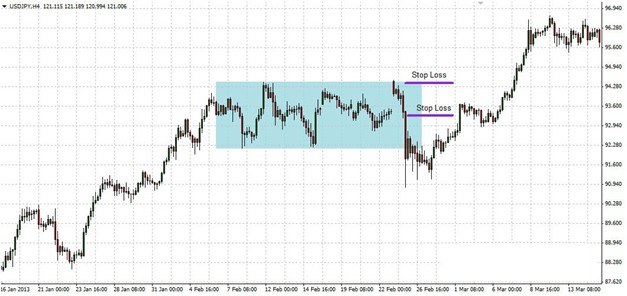
When trading a breakout from a consolidation range (using pending Buy Stop or Sell Stop orders), placing the stop loss correctly is critical to avoid “fakeouts.”
There are two logical placements:
- Conservative: At the opposite end of the consolidation range. This is safer but increases risk distance.
- Aggressive: At the midpoint (50%) of the consolidation range. If price falls back below the midpoint after a breakout, the breakout is likely false.
2. Stop Loss for Trend-Following Trades
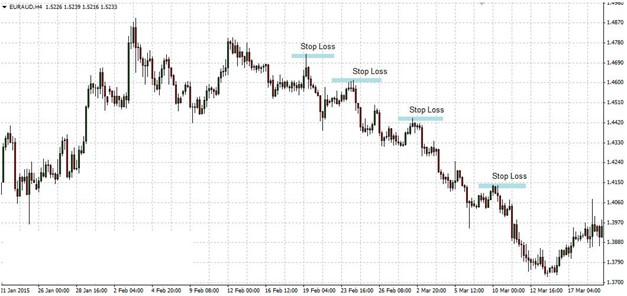
In trend-following or swing trading, positions are typically opened during pullbacks (corrections). The market structure provides natural protective levels.
- Uptrend (Buy): Place the Stop Loss slightly below the recent Swing Low (the lowest point of the pullback).
- Downtrend (Sell): Place the Stop Loss slightly above the recent Swing High.
As the trend progresses, you should manually trail your stop loss to the new structural levels formed by the market.
3. Stop Loss for Counter-Trend Positions
Trading against the trend (Counter-Trend) is risky and should be based on clear reversal patterns like a Double Top or Head & Shoulders. In these scenarios, the invalidation point is clear.
Example: If you sell on a Double Top formation, your Stop Loss should be placed just above the highs of the Double Top. If price breaks those highs, the reversal pattern has failed, and you must exit immediately.

4. More Sophisticated Methods for Managing Losses
Beyond chart structure, you can use mathematical or capital-based methods:
- ATR (Average True Range): Place the stop at a distance of 2 or 3 times the ATR value. This accounts for market volatility, ensuring you aren’t stopped out by normal market noise.
- Percentage Risk: Calculate your stop loss distance so that if hit, you lose only 1-2% of your total account balance. This ensures long-term survival.
Master your risk management.
Apply these stop-loss strategies on a robust trading platform and earn cashback on your volume.
Frequently Asked Questions
Is it better to use a tight or wide stop loss?
A tight stop offers a better risk-reward ratio but has a higher chance of being triggered. A wide stop has a higher win rate but requires a smaller position size to maintain risk. The “correct” width depends on market volatility.
What is a Buy Stop order?
A Buy Stop is an order to buy at a price higher than the current market price. It is typically used to enter a trade on a breakout of resistance.
Should I move my stop loss to break even?
Yes, once the trade has moved sufficiently in your favor (e.g., reached 1:1 risk-reward), moving the stop to break-even eliminates risk. However, doing this too early can result in being stopped out prematurely.
⚠️ Disclaimer: The content of this article is strictly for informational purposes and does not constitute investment advice. FXRebate is a cashback and affiliate service, not a broker or fund manager; responsibility for trades and funds lies exclusively with the third-party broker. Trading with leverage involves high risks of capital loss. Partner links used do not generate additional costs for you.