Forex Timeframes: Which One Should You Use?
⏱️ Estimated Reading Time: 5 minutes
📝 Summary: Choosing the right timeframe is critical for trading success. This guide compares short-term scalping with swing trading and End-of-Day strategies, helping traders align their chart analysis with their available time and lifestyle.
One of the most frequently asked questions in Forex trading is: “What is the best timeframe to use?” The answer isn’t universal; it depends entirely on your trading style, personality, and available time. However, understanding the pros and cons of each timeframe can help you avoid common pitfalls, such as overtrading or getting lost in market noise.
Table of Contents
Key Takeaways
- Noise Alert: Timeframes under 5 minutes are dominated by algorithmic noise and require fast reactions.
- Big Picture: Higher timeframes (H1, H4, D1) offer cleaner trends and more reliable signals.
- Lifestyle Fit: End-of-Day trading allows you to trade effectively without watching the screen all day.
- Multi-Timeframe: Always check a higher timeframe to confirm the dominant market trend.
1. Shorter Timeframes and Automated Trading
The smaller the timeframe, the more automated trading activity (High-Frequency Trading) you will encounter. On very short timeframes, such as 1-minute (M1) charts, you do not have time to think slowly or double-check your decisions.
When the price reaches a key level on an M1 chart, a strong counter-movement is likely to occur due to algorithmic orders reacting in milliseconds. For this reason, manual traders often find it difficult to compete here. A general rule of thumb for beginners is to avoid timeframes shorter than 5 or 15 minutes.
2. Swing Trading and Higher Timeframes
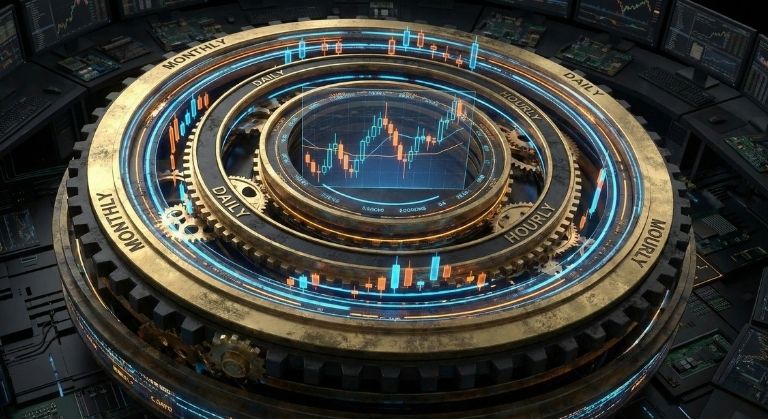
If you are considering swing trading (focusing on capturing price moves that last from a few hours to a few days), you should choose longer timeframes, such as 1-hour (H1) or 4-hour (H4) charts.
Crucial Rule: Never rely on just one timeframe. Always use “Multi-Timeframe Analysis.” Check a higher timeframe to understand the overall market trend.
- Scenario: On a 15-minute chart, the price may appear to be in a downtrend.
- Reality: On the 4-hour chart, the dominant trend might still be bullish, and the M15 drop is just a temporary pullback.
3. What If I Have a Full-Time Job?
Not everyone has the time to watch charts all day. If you are just starting your trading journey, you likely have other commitments. Does this mean you can’t trade?
Absolutely not. You can switch to End-of-Day (EOD) trading. This approach involves making trading decisions based primarily on the Daily (D1) chart.
Benefits of EOD Trading:
- Less Stress: You only need to check charts once a day (usually at market close/open).
- Stability: Positions remain open for several days, filtering out intraday noise.
- Volatility Protection: Stop-loss levels are placed further away, preventing you from being stopped out by random spikes.
- Profit Potential: Catching a major daily trend often yields larger profits than scalping for small pips.
4. Will My Strategy Work on Different Timeframes?
Yes. In most cases, a robust trading strategy will work on multiple timeframes. Price action principles (support, resistance, trends) apply whether you are looking at a weekly chart or a 5-minute chart.
However, minor adjustments might be necessary. You may need to optimize your stop-loss width and take-profit targets to match the volatility of the chosen timeframe. But do not worry—a well-developed trading approach remains effective across the board.
Trade on your own schedule.
Whether you scalp or swing trade, earn cashback on every transaction with FXRebate.
Frequently Asked Questions
What is the best timeframe for beginners?
Beginners are often advised to start with the Daily (D1) or 4-Hour (H4) charts. These charts move slower, giving you plenty of time to analyze and make decisions without pressure.
Can I trade multiple timeframes at once?
Yes, but ensure they are aligned. Use a higher timeframe (e.g., Daily) to determine the trend direction, and a lower timeframe (e.g., H1) to find your entry point.
Is scalping on 1-minute charts profitable?
It can be for experienced traders with strict discipline and low spreads. However, for most traders, the noise and transaction costs on M1 charts make it very difficult to be consistently profitable.
⚠️ Disclaimer: The content of this article is strictly for informational purposes and does not constitute investment advice. FXRebate is a cashback and affiliate service, not a broker or fund manager; responsibility for trades and funds lies exclusively with the third-party broker. Trading with leverage involves high risks of capital loss. Partner links used do not generate additional costs for you.