
Trading Rules Based on Macroeconomic Data
⏱️ Estimated Reading Time: 5 minutes
📝 Summary: This guide outlines a specific breakout strategy for trading major economic news releases, detailing how to use pending Buy Stop/Sell Stop orders to capture volatility without guessing the direction.
Missing out on an opportunity can be frustrating—such as failing to capitalize on market volatility triggered by an economic data release. While risky, news trading can be highly profitable if approached with diligence and experience. During such events, volatility may surge up to 40 times the normal level, offering significant returns in minutes.
Table of Contents
Key Takeaways
- Don’t Guess: Trying to predict the number is gambling. Trade the reaction, not the forecast.
- Breakout Orders: Use Buy Stop and Sell Stop orders to catch the move regardless of direction.
- Volatility: Prepare for massive slippage and widened spreads. Risk management is non-negotiable.
- Cancel Fast: If the news doesn’t trigger a move instantly, cancel your pending orders immediately.
1. Rely on Experience or Instinct?
There are two ways to approach news releases:
- Instinct: Acting immediately in the direction suggested by the fundamental release (e.g., buying USD because NFP was positive). This is dangerous because institutional algorithms react in milliseconds, often before you can click your mouse.
- Experience (Technical): Anticipating a breakout. This method ignores the data itself and focuses on the price channel formed before the announcement.
2. The Breakout Strategy
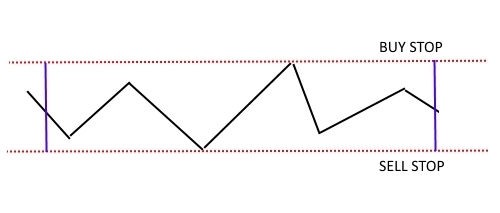
The most practical alternative for retail traders is breakout trading. The logic is simple: major news will cause a spike. We don’t know the direction, so we prepare for both.
- Identify the High and Low of the price range in the two hours leading up to the release.
- Place a Buy Stop order 5-10 pips above the High.
- Place a Sell Stop order 5-10 pips below the Low.
Whichever way the market explodes, one order gets triggered, and you ride the momentum.
3. 6 Rules for Macroeconomic News Trading
- Select the Event: Choose only high-impact data (NFP, Rate Decisions, CPI).
- Analyze History: Look at charts of previous releases. Did the pair react violently?
- Define the Channel: Mark the pre-release consolidation zone.
- Timing: Place your Buy Stop/Sell Stop orders just seconds before the release to avoid false triggers.
- Protection: Use Stop Losses at the channel’s opposite extreme.
- Management: If momentum wanes or price returns to the channel, exit immediately. False breakouts are common.
4. Real Case Studies
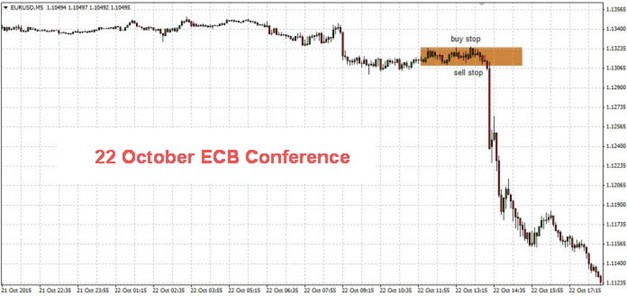
ECB Meeting (Oct 22, 2015)
Mario Draghi signaled a potential euro depreciation. The market broke the lower support of the pre-news channel, leading to a massive drop of over 100 pips in minutes. A Sell Stop order would have captured this entire move.
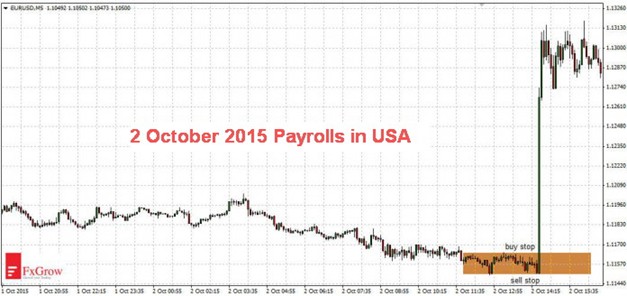
NFP Report (Oct 2, 2015)
Data came in weaker than expected. The initial reaction was a violent spike down, dropping 150 pips in 10 minutes. This is 30 times the typical ATR movement for that timeframe. Capturing even half of this move yields significant profit.
Trade the news safely.
Use a broker with fast execution to minimize slippage during news events.
Frequently Asked Questions
What is slippage in news trading?
Slippage occurs when your order is filled at a worse price than requested due to high volatility and low liquidity. It is a major risk during news.
Why place orders seconds before news?
If you place them too early, normal market fluctuations might trigger them before the news release, leaving you exposed to the wrong direction.
What if the price hits both buy and sell orders?
This is a “whipsaw” scenario and usually results in a double loss. If the first order is triggered and then price reverses strongly, close it immediately. This is why news trading is high risk.
⚠️ Disclaimer: The content of this article is strictly for informational purposes and does not constitute investment advice. FXRebate is a cashback and affiliate service, not a broker or fund manager; responsibility for trades and funds lies exclusively with the third-party broker. Trading with leverage involves high risks of capital loss. Partner links used do not generate additional costs for you.