
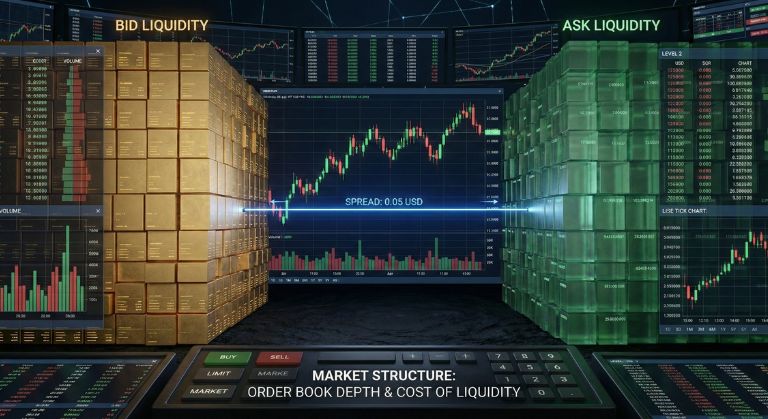
The Bid/Ask Spread: Where Should You Buy and Sell?
⏱️ Estimated Reading Time: 4 minutes
📝 Summary: This guide explains the mechanism of the Bid-Ask Spread, detailing how supply and demand influence prices, the hidden cost of trading, and strategies to minimize spread impact using limit orders.
If you’re entering your first trade, you’ve likely encountered terms such as spread, bid, or ask. Unless you’re an experienced trader, their connection to the market might still be unclear. The bid-ask spread directly influences the price at which a transaction is executed and affects the overall return of an investor’s portfolio. Understanding this hidden cost is essential for profitability.
Table of Contents
Key Takeaways
- Bid Price: The highest price a buyer is willing to pay (You sell at this price).
- Ask Price: The lowest price a seller is willing to accept (You buy at this price).
- Spread: The gap between Bid and Ask. This is the broker’s fee or the market’s cost.
- Liquidity: Higher liquidity generally leads to tighter spreads (lower costs).
1. Supply and Demand Basics
Before addressing the spread itself, it is crucial to understand the forces behind it:
- Demand: Reflects an investor’s willingness to pay a specific amount for a financial product.
- Supply: Refers to the available quantity or volume of that product offered for sale.
The spread exists because buyers want to pay less, and sellers want to receive more. The market maker or broker facilitates the trade by bridging this gap.
2. The Bid-Ask Spread Defined
The bid-ask spread represents the difference between:
- Ask Price: The lowest price a seller accepts. If you want to buy now (Market Order), you pay this higher price.
- Bid Price: The highest price a buyer offers. If you want to sell now, you accept this lower price.
Example: EUR/USD might be quoted as 1.1000 / 1.1002. The spread is 2 pips. If you buy and immediately sell, you lose those 2 pips instantly.
3. Liquidity and Spread Width
The size of the spread is determined by liquidity.
- High Liquidity (Major Pairs): In pairs like EUR/USD, there are millions of buyers and sellers. This competition forces the spread to be very tight (small).
- Low Liquidity (Exotic Pairs): In pairs like USD/ZAR, fewer participants mean wider gaps between what buyers offer and sellers want. The spread increases.
4. Strategy: Limit vs. Market Orders
The bid-ask spread can be thought of as an ongoing negotiation.
- Market Orders: You accept the current price immediately. You pay the spread. This guarantees execution but at a higher cost.
- Limit Orders: You set a specific price you are willing to pay. You essentially become a “market maker” by adding liquidity. You might avoid paying the full spread, but you risk your order not being filled if the price never reaches your level.
Traders looking to increase their success rate often use Limit Orders to avoid the “slippage” caused by wide spreads.
Trade with tight spreads.
Choose a broker with deep liquidity to minimize your transaction costs.
Frequently Asked Questions
Why does the spread widen during news?
During major news, liquidity dries up because banks pull their orders to avoid risk. The lack of orders creates a wider gap between buyers and sellers.
How is the spread calculated?
It is simply Ask Price minus Bid Price. If EUR/USD is 1.1002 (Ask) and 1.1000 (Bid), the spread is 0.0002, or 2 pips.
Is a fixed spread better than a variable spread?
It depends. Fixed spreads are predictable (good for news trading), while variable spreads are usually lower during normal market conditions (good for scalping).
⚠️ Disclaimer: The content of this article is strictly for informational purposes and does not constitute investment advice. FXRebate is a cashback and affiliate service, not a broker or fund manager; responsibility for trades and funds lies exclusively with the third-party broker. Trading with leverage involves high risks of capital loss. Partner links used do not generate additional costs for you.