
A Simple Trading Strategy: Breakout from the Night Channel
⏱️ Estimated Reading Time: 5 minutes
📝 Summary: This guide details a simple yet effective Forex strategy that exploits the overnight consolidation range (Night Channel). It explains how to set Buy Stop and Sell Stop orders to capture the morning breakout volatility.
One of the simplest and most robust trading systems relies on a basic market truth: periods of low volatility are often followed by periods of high volatility. This strategy, known as the “Breakout from the Night Channel,” exploits the typically narrow price range formed overnight to catch the morning momentum as the European session opens.
Table of Contents
Key Takeaways
- Time Window: Define the channel using the High and Low between 23:00 and 08:00.
- Automation: Use pending orders (Buy Stop/Sell Stop) to enter without staring at the screen.
- Risk Control: Place Stop Loss at the midpoint of the channel to minimize risk on false breakouts.
- Avoidance: If the night range is unusually wide, skip the trade (volatility is already spent).
1. The Concept: Night Channel
The Forex market tends to consolidate during the Asian session (especially for European pairs like EUR/GBP or EUR/USD). This creates a “Night Channel”—a box containing the price movement between late night and early morning.
Logic: When the London session opens (08:00 GMT), volume surges. The price usually breaks out of this narrow range violently. We don’t guess the direction; we set traps for both.
2. Setup and Entry Rules
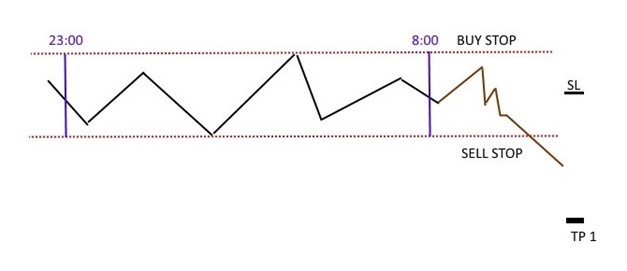
Step 1: Identify the High and Low of the price between 23:00 and 08:00.
Step 2: At 08:00, place two pending orders:
- Buy Stop: 1-2 pips above the channel High.
- Sell Stop: 1-2 pips below the channel Low.
Step 3: Ideally, use an OCO (One Cancels the Other) order. If the Buy Stop is triggered, the Sell Stop is automatically cancelled.
3. Risk Management & Exits
False breakouts are the enemy of this strategy. To protect your capital:
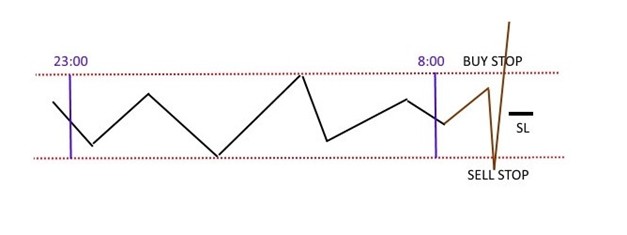
- Stop Loss (SL): Place the SL at the midpoint (50%) of the channel. Placing it at the opposite side is safer but reduces your Risk/Reward ratio.
- Take Profit (TP): The minimum target should equal the height of the channel (1:1 ratio).
- Partial Close: Close 50% of the position at the first target and move SL to break-even. Let the rest run.
4. Real Trade Example (EUR/GBP)
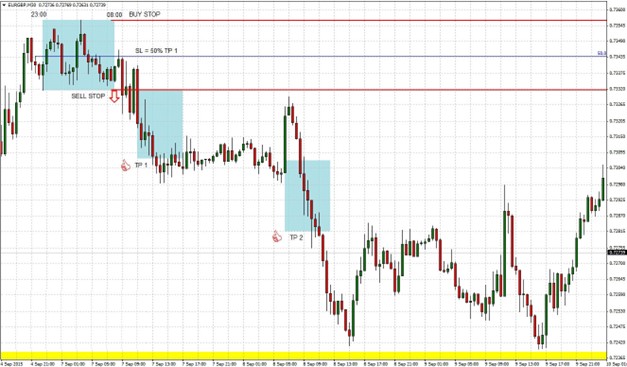
In this EUR/GBP example, the blue box defines the overnight range. Shortly after 08:00, the price broke lower, triggering the Sell Stop.
- The price did not retrace to the 50% midpoint, keeping the SL safe.
- At TP1, half the position was closed.
- The Stop Loss was moved to Entry.
- The remaining position was closed at TP2, achieving a final Risk/Reward ratio of 1:3.
Automate your morning trades.
Execute breakout strategies with precision and get paid for every trade.
Frequently Asked Questions
What pairs work best?
Pairs involving European currencies like EUR/USD, GBP/USD, and EUR/GBP work best because they tend to be quiet during the Asian session and active during the London session.
What if the channel is very wide?
Skip the trade. A wide channel indicates that volatility was high overnight. The market may be exhausted, increasing the chance of a false breakout.
When should I cancel the orders?
If neither order is triggered by 10:00 or 11:00 am, it is usually best to cancel them. The morning momentum has passed, and the setup is no longer valid.
⚠️ Disclaimer: The content of this article is strictly for informational purposes and does not constitute investment advice. FXRebate is a cashback and affiliate service, not a broker or fund manager; responsibility for trades and funds lies exclusively with the third-party broker. Trading with leverage involves high risks of capital loss. Partner links used do not generate additional costs for you.