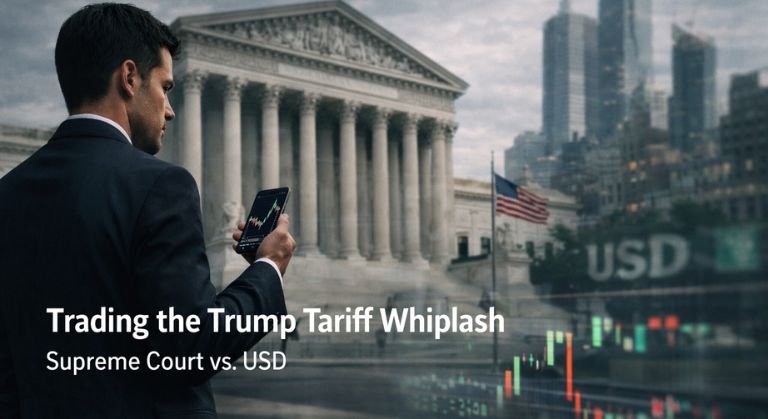
Trading the Trump Tariff Whiplash: Supreme Court vs. USD
�?��? Estimated Reading Time: 6 minutes
�? Summary: Political shifts often create the most aggressive market movements. This explainer breaks down the recent Supreme Court ruling on US trade tariffs, the administration's rapid 150-day pivot, and the resulting massive USD tariff reaction across commodity currencies.
For forex traders, geopolitics and legal battles are not just news headlines—they are direct catalysts for market volatility. Recently, the financial markets experienced an extraordinary 48-hour period of legal whiplash. The US Supreme Court struck down a sweeping tariff regime, only for the executive branch to immediately implement a new, temporary tariff structure just hours later.
Understanding the mechanics behind this sudden shift is critical. It is not just about the political drama; it is about recognizing how temporary legal authorities shape inflation expectations, influence central bank policies, and ultimately drive the value of the US Dollar against trade-sensitive currencies.
Table of Contents
Key Takeaways
- Legal Limits: The Supreme Court ruled that the IEEPA does not grant the executive branch sweeping power to tax imports.
- The Pivot: The administration immediately invoked Section 122 of the Trade Act of 1974, applying a temporary 15% tariff limit for 150 days.
- Currency Impact: Trade-sensitive currencies like AUD, NZD, and CAD are experiencing wild swings as traders price in the uncertainty of the July 2026 deadline.
1. The Supreme Court's Shocking Decision
According to the US Constitution, the power to levy taxes—including tariffs on imports—rests solely with Congress. However, over the decades, Congress has passed various laws delegating emergency trade powers to the president. The administration initially relied on the International Emergency Economic Powers Act (IEEPA) of 1977 to justify its broad tariff structure, citing national security threats and severe trade deficits.
In a historic 6-3 ruling, the Supreme Court struck down this interpretation. The Court clarified that the IEEPA does not explicitly grant the power to impose sweeping, economy-wide taxes. Suddenly, billions of dollars in collected tariffs were thrown into legal limbo, raising the possibility of massive corporate refunds and injecting immediate uncertainty into the financial system.
2. The 150-Day Clock: What is Section 122?
The market had barely digested the Supreme Court's ruling when the administration pivoted. Within hours, a new legal justification was announced: Section 122 of the Trade Act of 1974. Unlike the previous law, Section 122 explicitly allows for temporary import surcharges to combat severe balance-of-payments deficits.
However, this new authority comes with two strict limitations. First, the maximum allowable tariff is capped at exactly 15%. Second, the authority strictly expires after 150 days (landing around late July 2026). This sets up a ticking clock. The administration now has a brief window to execute deeper, more permanent trade investigations (like Section 301) before the temporary tariffs vanish.
3. How the US Dollar and Commodity Currencies Reacted
The initial Supreme Court ruling caused an immediate, sharp sell-off in the US Dollar. The market logic was straightforward: removing tariffs lowers domestic inflationary pressures, which in turn reduces the likelihood of the Federal Reserve keeping interest rates higher for longer. Consequently, commodity and trade-linked currencies like the Australian Dollar (AUD) and New Zealand Dollar (NZD) surged.
This euphoria was short-lived. Once the 15% Section 122 tariff was announced over the weekend, the markets opened to a reality check. The USD clawed back a significant portion of its losses against major pairs, while trade-sensitive economies found their currencies under pressure once again. The result was highly choppy, directionless price action as institutions struggled to price in a tariff policy that now has a hard expiration date.
4. Trading the Volatility Moving Forward
The transition from a permanent tariff regime to a temporary 150-day window guarantees one thing for forex traders: sustained volatility. Over the next few months, expect wild swings on every piece of news related to trade negotiations, Congressional responses, or secondary legal challenges.
Traders should be particularly cautious when holding positions in pairs like AUD/USD, USD/CAD, and USD/MXN over the weekends, as sudden executive announcements can cause massive opening gaps. Utilizing strict stop-losses and avoiding over-leveraging during headline-heavy sessions will be critical to surviving the "tariff whiplash."
Turn Market Volatility Into Cashback
News-driven markets mean more trading opportunities and higher volumes. Link your broker account to FXRebate today and get paid for every trade you execute.
Frequently Asked Questions
Why do US tariffs generally cause the US Dollar to strengthen?
Tariffs act as a tax on imported goods, which raises consumer prices (inflation). When inflation rises, the Federal Reserve is more likely to increase interest rates, which attracts foreign capital and boosts the value of the US Dollar.
Which currency pairs are most sensitive to tariff news?
Currencies belonging to major export-driven economies are highly sensitive. You will see the most aggressive reactions in pairs like the Australian Dollar (AUD/USD), Canadian Dollar (USD/CAD), New Zealand Dollar (NZD/USD), and Mexican Peso (USD/MXN).
How can FXRebate help during highly volatile news events?
During major news events, brokers often widen their spreads due to rapid price fluctuations. By connecting your trading account to FXRebate, a significant portion of those spread costs and commissions is automatically refunded to you, lowering your overall trading expenses.
⚠️ Disclaimer: The content of this article is strictly for informational purposes and does not constitute investment advice. FXRebate is a rebate and affiliate service, not a broker or fund manager; responsibility for trades and funds lies exclusively with the third-party broker. Trading Derivatives carries a high level of risk to your capital and you should only trade with money you can afford to lose. Trading Derivatives may not be suitable for all investors, so please ensure that you fully understand the risks involved, and seek independent advice if necessary. Partner links used do not generate additional costs for you.