Prop Firms
Quick answer
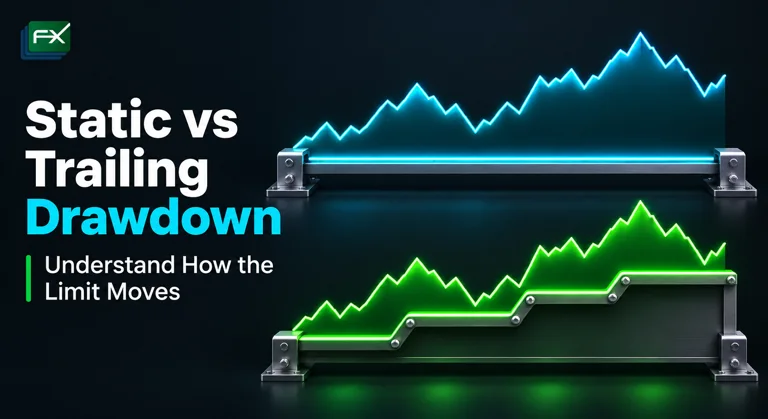
“Drawdown” is not one universal calculation. A static limit usually stays anchored to a defined starting value, while a trailing limit can move as the account reaches new highs. The rule may track balance, equity or both, and may update intraday or at a stated checkpoint. Read the firm’s exact calculation, because a short label cannot tell you when a breach occurs.
Static drawdown
A static limit is generally set relative to a starting balance or another fixed reference. If the threshold does not move as the account grows, it can be easier to map in advance. But “static” does not automatically explain whether floating losses count, whether the limit is intraday, or what happens after a withdrawal. Those details still matter.
Trailing drawdown
A trailing threshold moves according to a defined measure of account performance. It might rise with a new high-water mark, follow balance or equity, or stop trailing after a specified level. If it follows equity, open positions can affect the calculation before they are closed. The exact mechanism differs among providers.
Questions to answer in the rulebook
- What is measured? Balance, equity, end-of-day equity or another value?
- When is it measured? Continuously, intraday, at market close or at a scheduled reset?
- What is the reference point? Starting balance, highest balance, highest equity or a fixed amount?
- Does the line move? If so, when does it move, and can it ever move down?
- What happens after a payout? Does the threshold reset, remain fixed or change by formula?
- What counts as a breach? A touch, a close beyond the limit, a daily loss or a combined rule?
| Feature | Static limit | Trailing limit |
|---|---|---|
| Reference | Usually fixed starting point | Often a moving high-water point |
| Main planning task | Know the fixed threshold | Understand when and how it trails |
| Open-trade effect | Depends on balance/equity definition | Can be material if equity-based |
| After payout | Check whether the fixed reference changes | Check the recalculation/reset terms |
Why examples help
Ask the provider for an official example using a losing open position, a new account high and a withdrawal. Work through the arithmetic using the same measurement and timing in the rules. If the example conflicts with the written terms, request clarification before paying.
Avoid comparing only the headline drawdown percentage. Two firms may use the same percentage but different bases, timing and reset rules. Those differences can change how much room the strategy has during an open trade or around a payout.
FAQ
Is static drawdown always easier?
Not necessarily. It may be more predictable, but the remaining distance to the limit still depends on how the firm measures losses and whether other daily limits apply.
Does trailing drawdown always stop at the starting balance?
No universal rule applies. Some firms specify a floor or lock point; others use a different method. Verify the current product rules.
Do floating losses count?
Only the provider’s definition can answer this. Look for “equity,” “open P&L,” intraday monitoring and breach timing in the official rules.
Sources
Your next step
Explore FXRebate
Compare the broker and rebate information currently published by FXRebate. Any offer depends on the listed partner, account route and eligibility terms.