Crypto
Quick answer
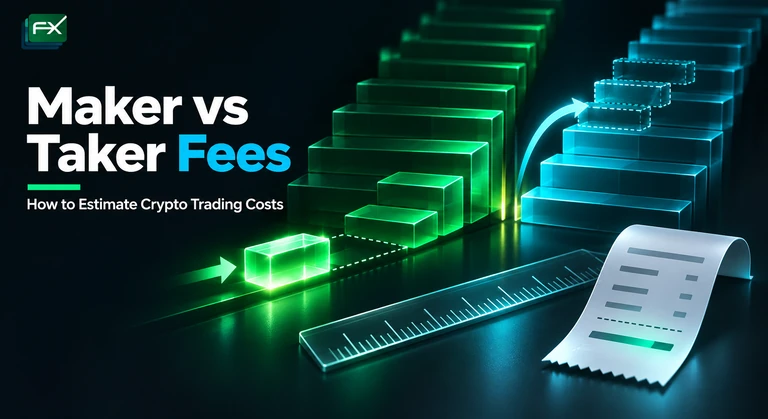
On many order-book exchanges, a maker order adds liquidity to the book, while a taker order executes against liquidity already there. The exchange may charge different fees for each, but order type alone does not guarantee maker treatment: a limit order that immediately matches can be charged as a taker. Estimate both sides of the transaction and include spread, slippage, funding or network costs where relevant.
What “maker” and “taker” mean
A resting limit order that waits in the order book may be treated as a maker order. An order that fills against an existing order removes liquidity and is generally a taker. Some exchanges offer a post-only instruction designed to prevent immediate execution; if it would execute immediately, the order may be rejected or cancelled. Exact treatment is platform-specific.
Market orders are commonly taker orders because they seek immediate execution. A marketable limit order can also be a taker if it crosses the spread and matches existing orders. The exchange’s fee schedule—not the button label—is authoritative.
Calculate the visible fee
For a simple percentage fee:
Fee = executed notional × applicable fee rate
If a trade has multiple fills, calculate the fee for each fill under the applicable rate and add them. Check whether the fee is charged in the quote asset, base asset or another token, and whether VIP tier or a discount changes the rate.
Add the less visible costs
- Bid/ask spread: the gap between the best available buy and sell prices.
- Slippage: the difference between the expected and actual execution price, especially for larger or fast-moving orders.
- Funding or borrowing: may apply to perpetual futures, margin or borrowed balances.
- Conversion and withdrawal: may apply when changing assets or moving funds off-platform.
- Promotion exclusions: zero-fee or special pairs may not count toward volume or rewards.
| Cost element | How to check it |
|---|---|
| Maker/taker fee | Current exchange fee schedule and your account tier |
| Spread/slippage | Order book depth and actual fills |
| Funding/borrow | Product-specific rate and payment interval |
| Conversion/withdrawal | Asset, network and destination fee schedule |
| Rebate/reward | Eligible fees, pairs, dates and credit conditions |
Where a rebate fits
A valid rebate may reduce some eligible trading costs after the fee is incurred or under the program’s stated credit process. It does not erase spread, slippage, funding or market risk. Compare the net cost only after confirming the exact eligible fee base and reward conditions. A voucher with a cap or expiry is not equivalent to an unconditional cash rebate.
FAQ
Is every limit order a maker order?
No. If it executes immediately against resting orders, it can be charged as a taker. Use the exchange’s post-only feature only if you understand how it handles orders that would cross the spread.
Are maker fees always lower?
No universal schedule exists. Some providers use different rates, zero-fee pairs, negative maker fees or tier-based schedules. Check the live fee table for your account and market.
Does a rebate make a high-cost trade profitable?
No. A rebate is only one cost component. It cannot guarantee a favorable execution or offset losses caused by price movement.
Sources
Your next step
Explore FXRebate
Compare the broker and rebate information currently published by FXRebate. Any offer depends on the listed partner, account route and eligibility terms.