
Attempting to Catch Market Tops and Bottoms – A Common Mistake
⏱️ Estimated Reading Time: 5 minutes
📝 Summary: Trying to predict the exact peak or trough of a market is a common pitfall. This article explains why fighting the trend leads to losses and analyzes a case study on the DAX index.
Attempting to pinpoint the exact tops and bottoms in the market is a prevalent mistake, especially among novice traders. While the allure of selling at the absolute peak is strong, this strategy often puts traders on the wrong side of the market. The golden rule remains: “The trend is your friend.”
Table of Contents
Key Takeaways
- Trend Alignment: Seasoned investors ride the uptrend; novices try to short it prematurely.
- Illusion of Predictability: Highs and lows are obvious in hindsight but elusive in real-time.
- Low Probability: Approximately 90% of trend reversal attempts fail and are merely corrections.
- Confirmation: Never enter a reversal trade based on a single candlestick; wait for structural confirmation.
1. A “Naive” Mistake
When markets react significantly to major events, many traders aspire to be “smarter than the market.” While experienced traders look for entry points to join the uptrend, inexperienced traders often attempt to short the market, erroneously believing they have identified the absolute high.
From a beginner’s perspective, identifying peaks seems straightforward on a historical chart. However, this is the illusion of hindsight bias. Real-time trading requires dealing with uncertainty, not past data.
2. The Reality: 90% Fail Rate
Opening positions against the prevailing trend—without confirmation—is a near-certain path to capital loss. Statistically, approximately 90% of trend reversal attempts are merely temporary corrections. Betting on that 10% chance is not a viable long-term strategy.
3. Case Study: A Risky Short on the DAX Index
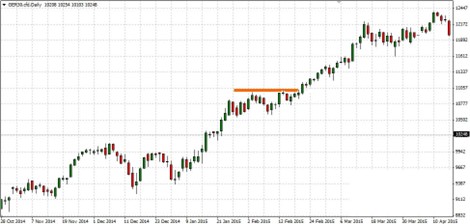
Consider a real-world example involving the DAX index in February 2015. After breaking through the 10,100 resistance level, the index surged to 11,000. Despite visible signs on the daily chart that the bullish trend might be nearing exhaustion, initiating a short position based on a single candlestick reversal was premature.
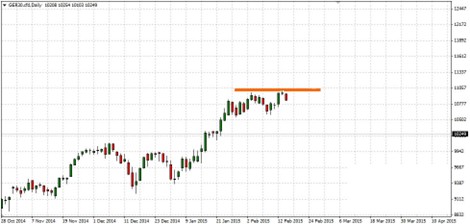
Traders who sold early were squeezed as the market continued to rally. The key takeaway is that trading decisions should be grounded in directional confirmation, not assumptions.
4. Conclusion
Always remember: “The trend is your ally.” Trying to be a hero by calling the top usually results in becoming a victim of the trend.
Trade with the trend, not against it.
Join FXRebate today and earn cashback on every trade, whether the market goes up or down.
Frequently Asked Questions
Why is catching tops and bottoms dangerous?
Because momentum is often stronger than it appears. Betting on a reversal without confirmation means fighting the entire market flow, leading to high probability of loss.
When is it safe to trade a reversal?
Only after the market structure has broken (e.g., a Lower Low in an uptrend) and retested. This provides confirmation that the trend has actually changed.
What does “The trend is your friend” mean?
It means that statistically, prices are more likely to continue in their current direction than to reverse. Aligning your trades with the trend increases your success rate.
⚠️ Disclaimer: The content of this article is strictly for informational purposes and does not constitute investment advice. FXRebate is a cashback and affiliate service, not a broker or fund manager; responsibility for trades and funds lies exclusively with the third-party broker. Trading with leverage involves high risks of capital loss. Partner links used do not generate additional costs for you.